At half past six the cottage lights failed. The phone was on 14 per cent, and the little charger in the kitchen drawer was already empty. I had used it on the train from London and never put it back on a socket.
What I needed was a lamp, a message to the owner, and the laptop, because a document was due before Sunday. The car’s USB socket would trickle a phone. It would not keep the laptop going, and I was not going to idle the engine in the yard.
On Saturday the cottage power was back, so we drove to a small site further along the north Norfolk coast. The pitch had no hook-up, and petrol generators were not allowed. By late afternoon the laptop was down again, and the pocket charger was empty for the second time.
A pocket battery was the wrong guess
The mistake had a name. I had been treating “portable power” as a synonym for a battery shaped like a chocolate bar. That object charges a phone on a train. It does not pretend to be a socket, and it should not be asked to.
The thing I did not want was a heater, a kettle, or any box sold as if it could run a kitchen. The pitch was a tent and a table. The job was a laptop charger, two phones, a small lamp, and maybe the camera. Petrol was out because of the site rule, and because I will not run an engine inside a tent or beside one.
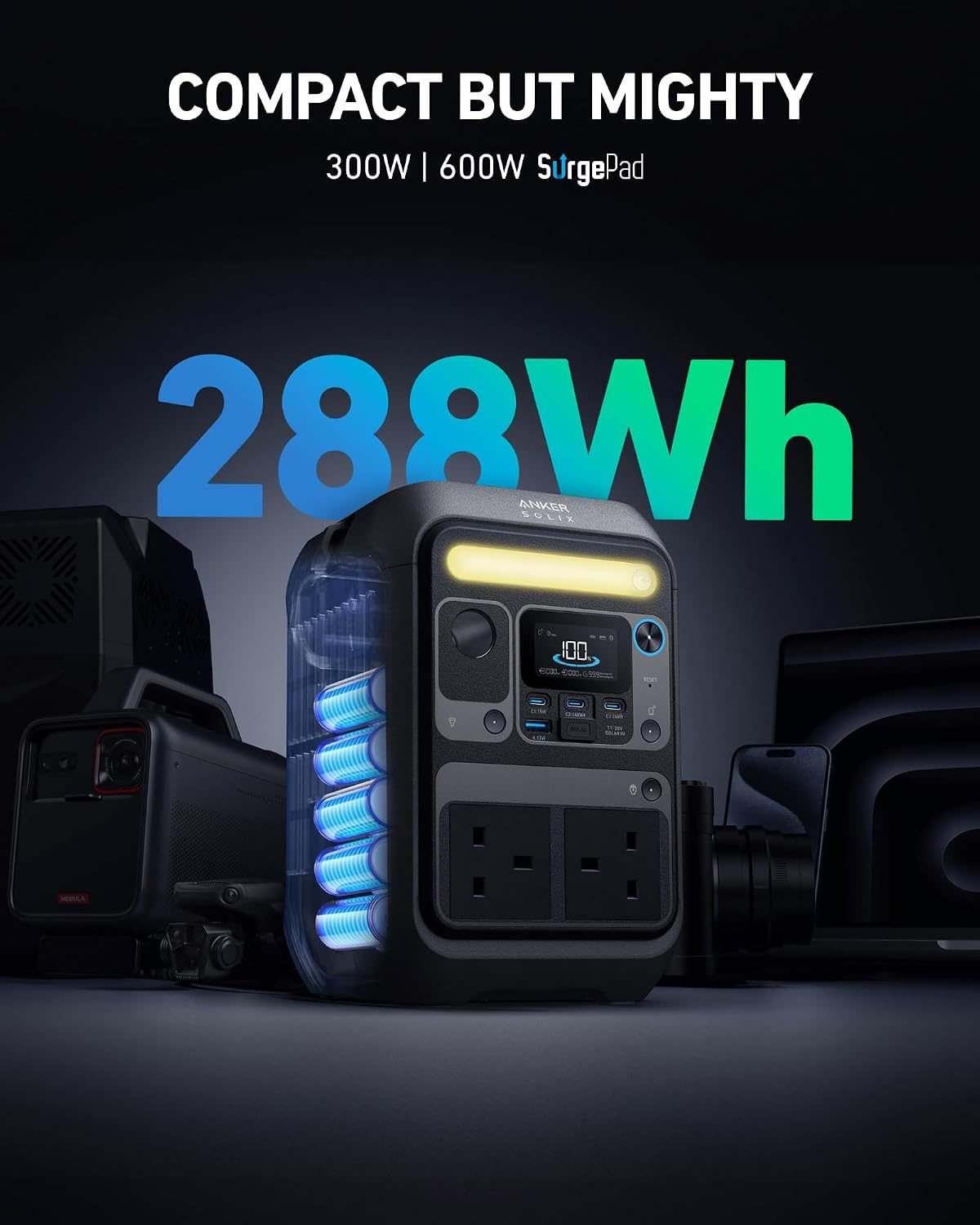
So the search, in this illustration, narrows to something you can lift onto a table: an AC socket for the laptop brick, USB ports for the phones, and a way to take a charge from daylight if the afternoon stays clear. That is the moment the product enters. The link at the end of this page opens Amazon UK ASIN B0D62GMQ3F. The title on that listing is the Anker SOLIX C300X portable power station: 300 watts, 288 watt-hours, a LiFePO4 battery, and a carrying case. People sometimes call this sort of box a solar generator. A solar panel is not in every style on that page.
Anker makes the station. An Amazon UK seller lists it. Blogafif is the publishing name of DIGITAL MEDIA LIMITED. Blogafif does not make the station and does not sell it. The details table on the listing shows model A1723. The style names on the same page are C300X+Bag, C300X-New, C300X+60W and C300X+100W. The button at the end of this page opens ASIN B0D62GMQ3F in this same tab. Read the title and the style name before you buy. The buy box is the current record of price and stock. This article does not quote a price.
What actually switched the lamp back on
In the illustration the useful part was dull, which is the point. The listing states two AC sockets at 300 watts, and a 600 watt peak with SurgePad. The laptop charger plugged in the way it does at a kitchen worktop. A small LED lamp plugged in beside it. The phones used USB rather than an AC socket, which is the sensible way to spend the watt-hours.
The same bullets list two USB-C ports at 140 watts, one USB-C port at 15 watts, a USB-A port at 12 watts, and a car socket at 120 watts. They also state 25 decibels at 1 metre. I am repeating the listing, not a reading taken on the grass. The questions on the page add that only one of the USB-C ports both charges the station and powers a device. Confirm that port map on the seller page before you buy. The comparison you can make without a meter is enough: it is not a petrol generator, and a site that bans engines has no reason to mind a quiet box on a table.
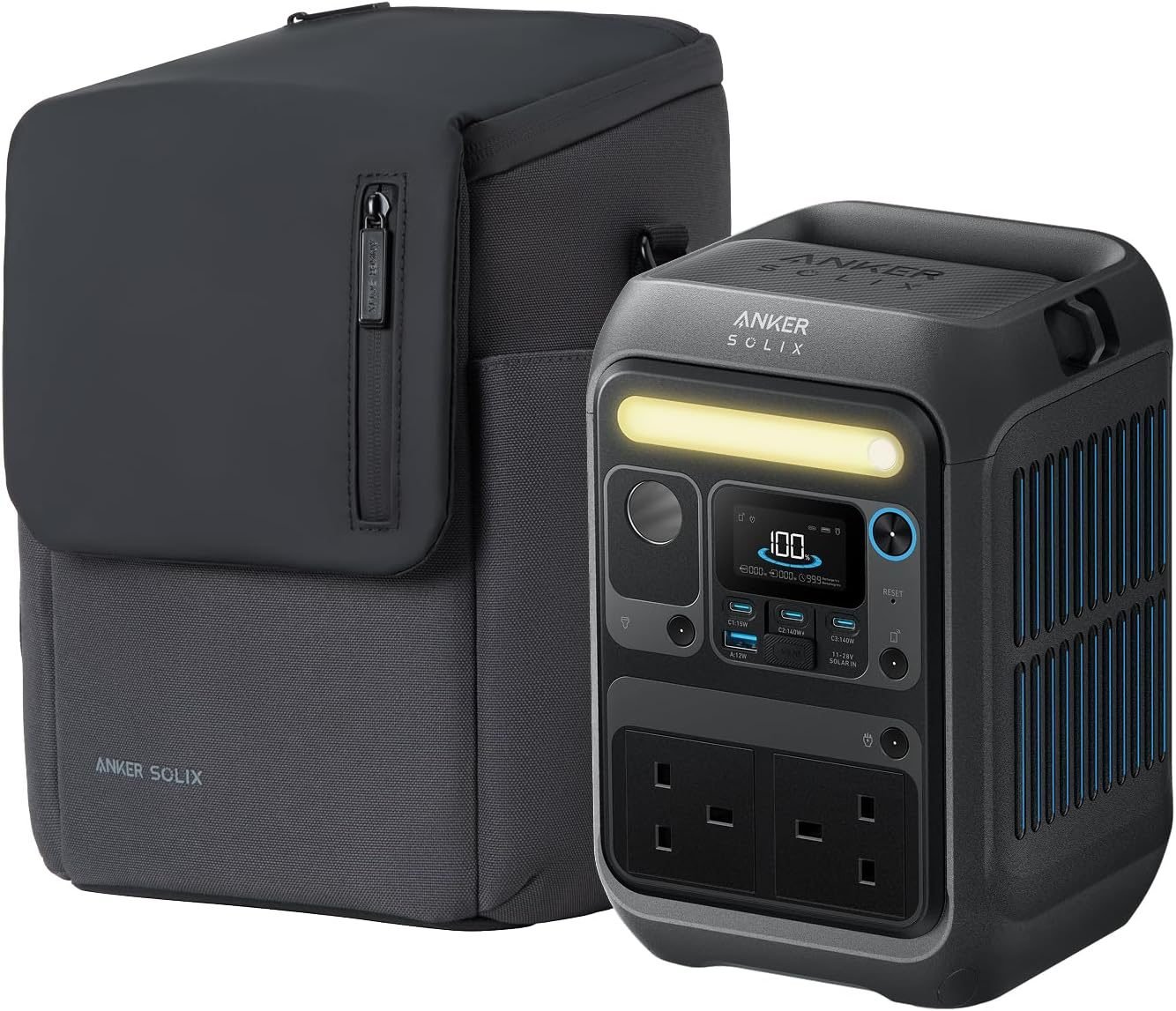
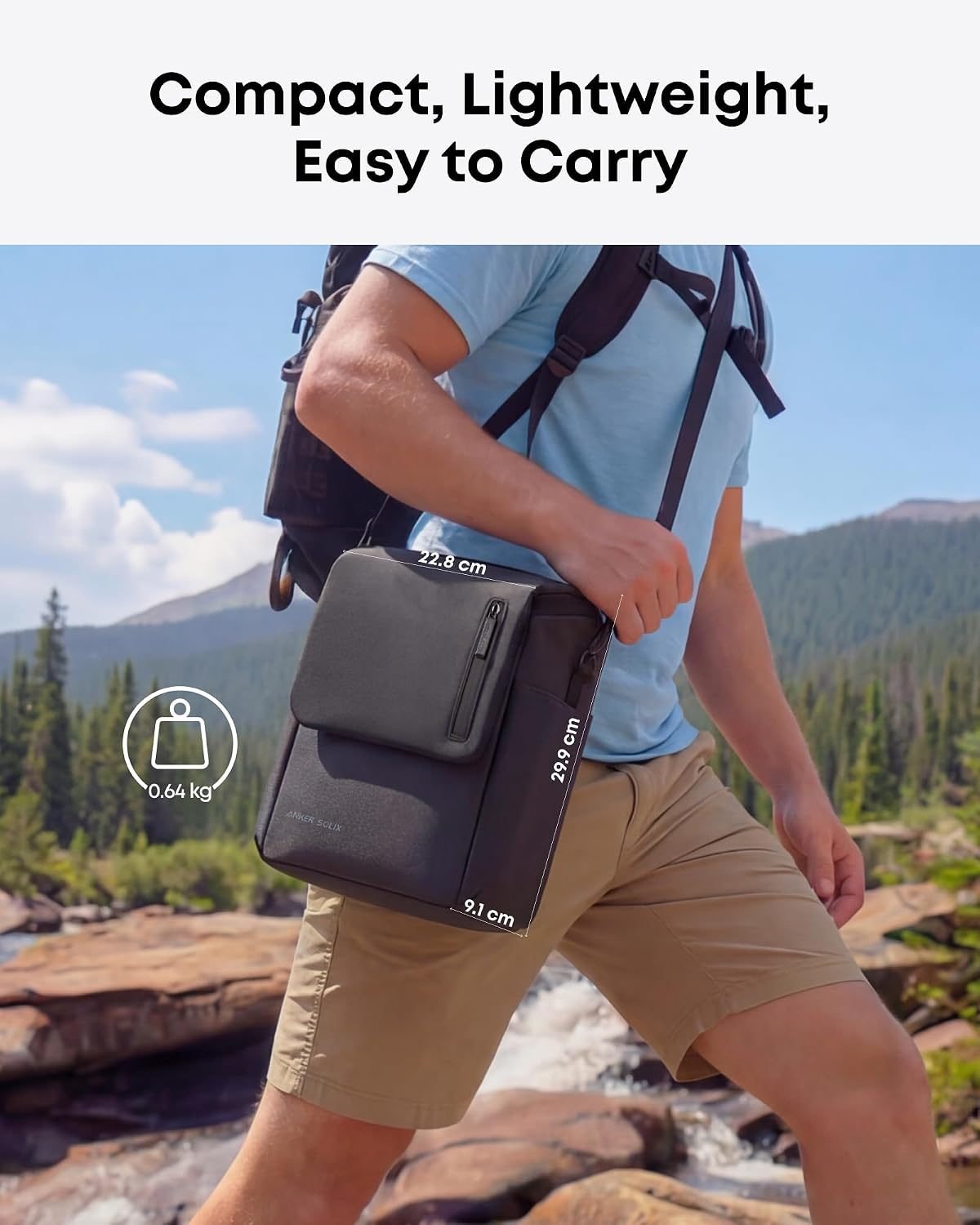
The product details beside the buy box state 4.13 kilograms, and 23.7 by 23.5 by 28.7 centimetres. A comparison chart further down the same page still lists an Anker SOLIX C300 at about 16.4 by 16.1 by 24 centimetres and 4.1 kilograms. Those are different lines. In the scene the station sat on the camping table, not in a coat pocket. For the style named C300X+Bag, the included-components line is the power station, an adjustable strap and a carrying case. It does not name a solar panel. Confirm the style and the carton on the seller page before you buy.
I did not need the cottage back. I needed the lamp, the laptop, and a phone that could send one message.
What the weekend still could not do
The laptop finished the document. The phones charged. That is the whole triumph, and it should stay that size. When the cottage mains came back, the ordinary wall sockets were still the right place for anything hungry. A portable station of this class is a bridge across a few hours. It is not a second house.
The panel is a separate purchase
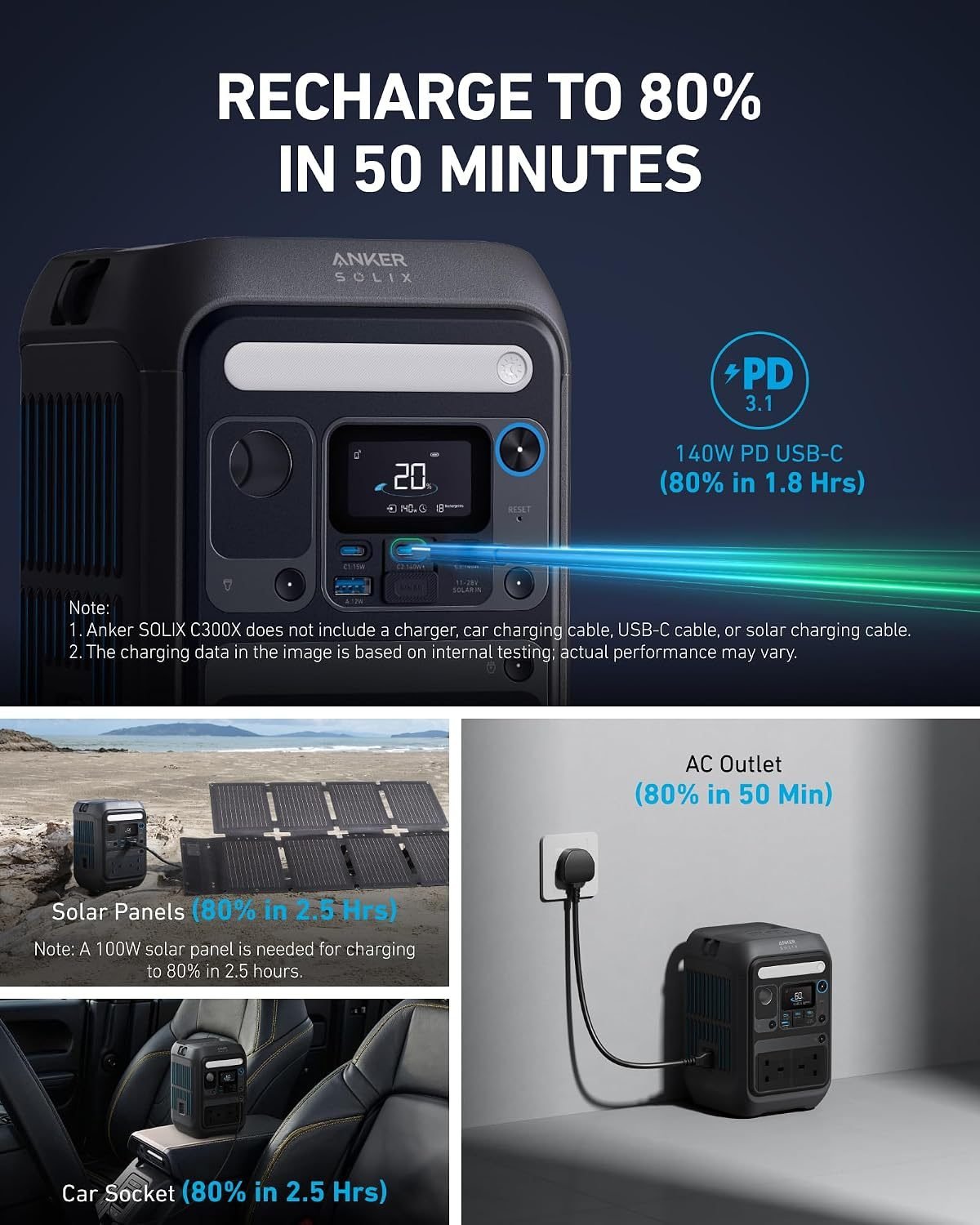
A fold-out solar panel is not in the bag-style list. The same listing has other styles, C300X+60W and C300X+100W, which are the ones that add a panel, and C300X-New, which does not. The questions on the page say to use an 11 to 28 volt panel with an XT60 connector, and they point to a 60 watt or 100 watt Anker panel. They say this station is not compatible with the Anker SOLIX PS30, or with other 5 volt, 3 amp USB-C panels, and that an Anker panel over 100 watts can make the unit misbehave. The car-charging cable and the solar cable are separate purchases. A bright hour on the Norfolk coast is not a promise of 100 watts. Cloud, angle and the time of day all change what a panel actually gives.
Recharging, on the listing’s own figures, can be done from a mains socket, which it says will take the unit to 80 per cent in about 50 minutes; from a compatible solar panel, which it says will take the unit to 80 per cent in about 2.5 hours; from a car socket with the separate cable; or from the USB-C port it rates at 140 watts. Those are the listing’s figures. They are not a stopwatch result from this weekend. The solar time assumes a panel, and the bag style does not list one.
300 watts is a ceiling, not a suggestion
The limit that matters more than the brochure is the ceiling. Three hundred watts of rated AC output will cover a laptop charger, a light, a router, a phone. It will not run a kettle. It will not run a heater. It will not run an electric hob. If the job is warmth or boiling water, this is the wrong product, and no amount of hopeful reading will change the label on the appliance.
The listing states a SurgePad peak of 600 watts on the AC sockets. SurgePad is still the wrong tool for heating, and it is not a promise that every appliance under 600 watts will start. Motors are a different question from a laptop brick. If a device’s label shows a draw above 300 watts, treat it as outside this unit until the manual on the seller page says otherwise.
Hours are arithmetic, not a promise
Capacity is 288 watt-hours. That is a size, not a number of hours. A thirsty laptop and a quiet lamp do not consume the same thing. Anyone who needs a rough sense of runtime can divide the device’s watts into 288 and then expect less, because conversion is not perfect. Anker does not promise a particular evening, and I will not invent one. A neighbour’s phone, a different laptop brick, a colder battery: all of that moves the result.
A cold morning is a charging limit
The listing does not put a cold-weather charging range next to the buy box. If a frosty morning matters, read the manual linked from the seller page before you rely on a charge. Do not force a charge the manual forbids.
The details table states a five-year warranty. That line is not a promise that the unit in your boot will still be healthy years from now. Confirm the warranty on the seller page before you buy.
The sockets and ports are on the unit. A comparison chart on the page marks an app connection on a C300 column, which is not the same line as the C300X buy box. Nothing here is a reason to run medical equipment, a fridge, or a whole kitchen from a 300 watt box.
Confirm the listing in front of you
The page this article links to shows more than one style. Before you pay, confirm the style selected in the buy box, the model number in the details table, and ASIN B0D62GMQ3F. The details table read for this article showed model A1723 and the bag style, with a carrying case and an adjustable strap, and no solar panel in that components line. A 60 watt or 100 watt style, a DC-only cousin, or a much larger home-backup station is a different purchase. Price, delivery, stock and returns belong to the Amazon UK seller. Confirm them on the seller page before you buy. Blogafif does not hold the stock.
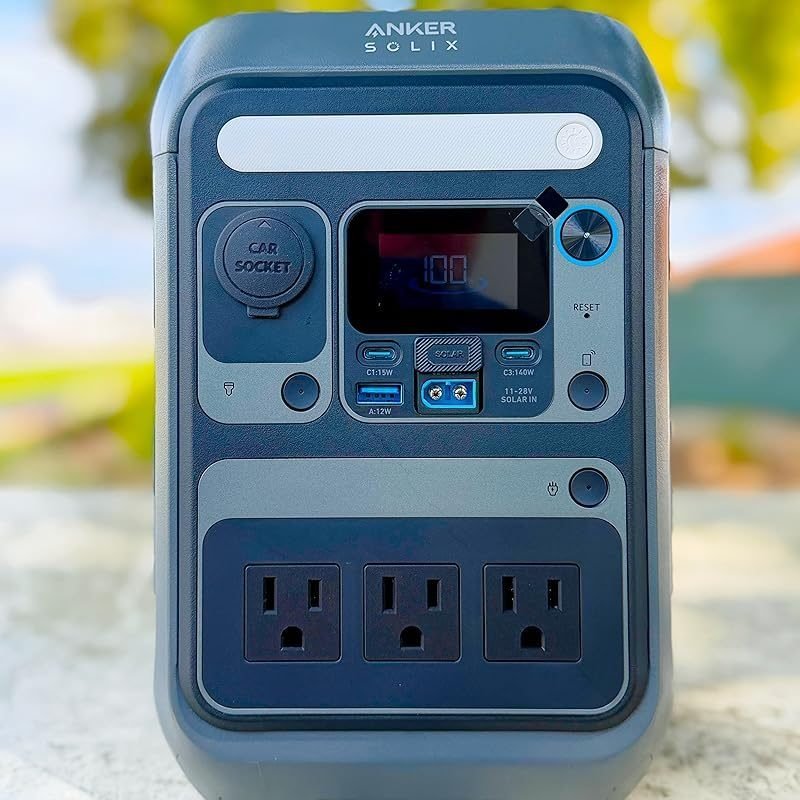
-
01
288Wh battery
The listing title states 288Wh and a LiFePO4 battery for the C300X.
-
02
300W AC sockets
The listing states two AC sockets at 300W, and 600W peak with SurgePad.
-
03
Solar input, extra
Up to 100W, 11–28V. Not in the bag style. The 60W and 100W styles are separate.
-
04
About 4.13 kg
Buy-box details: 4.13 kg and 23.7 × 23.5 × 28.7 cm. Confirm the style on the seller page.
-
05
Four ways to recharge
Socket, solar, car or USB-C, on the listing’s figures. Car and solar cables are separate.
-
06
A hard ceiling
Not for kettles, heaters or other high-draw appliances. Rated AC power on the listing is 300W.
Who this is for, if the evening sounds familiar
It fits a person who wants phones, a laptop and a small lamp through a power cut, or a pitch without a hook-up, and who can live with a 300 watt ceiling and a weight of about 4.13 kilograms. It does not fit a person who wants to heat a room, boil water, or keep a house running. Those are different machines.
In the illustration, the relief was ordinary. The document went in. The lamp was a lamp again. The pocket charger stayed in the drawer, which is where a pocket charger belongs. Nothing about that evening proves what your weekend, your laptop, or your weather will do.
If the job you actually have is the small one, the next step is the seller’s listing, not a second opinion from this page. Confirm the model. Read the seller’s price, delivery and returns. Then decide.